
We Will Not Forget
No matter how much history they delete and replace with propaganda.

“History does not repeat itself, but it often rhymes,” Don Henley said from the stage at the Sphere, right before he sang “The End of the Innocence” with the Eagles.
The words, and that he spoke them aloud to thousands, gave me chills.
Two hours of music under that vaulted dome, strangers singing the same lines at once; for a moment, the world felt stitched back together. Henley said plainly, “Music is medicine.” The room believed him, and for a little while, we all took that medicine together.
I was there with my daughter, who laughed and called our recent string of concerts my “retribution tour.” She was teasing, but she was right. We’ve been choosing shows, Green Day a week ago and the Eagles now, by instinct and conscience: artists who refuse to stay silent. That choice feels like civic muscle. It feels like keeping a light on.
I carry one small, sharp regret: I never took my daughters to Jimmy Buffett’s last San Diego show. It sits in me like sand in a shoe. Under the Sphere’s blue light, that regret hardened into a promise: we will not miss the things that matter. We will say yes. We will bring them with us, even when it feels frivolous, while the world is burning around us.
These are strange days, both the best of times and the worst of times braided together.
Showing up for joy is not retreat; it is how we refill. Pleasure is not frivolous. It recharges us so we can stand, call, and fight when the work is heavy and the odds look long. Living and loving in public is a quiet kind of resistance, and it gives us the strength to carry on even when it feels like nothing will change.
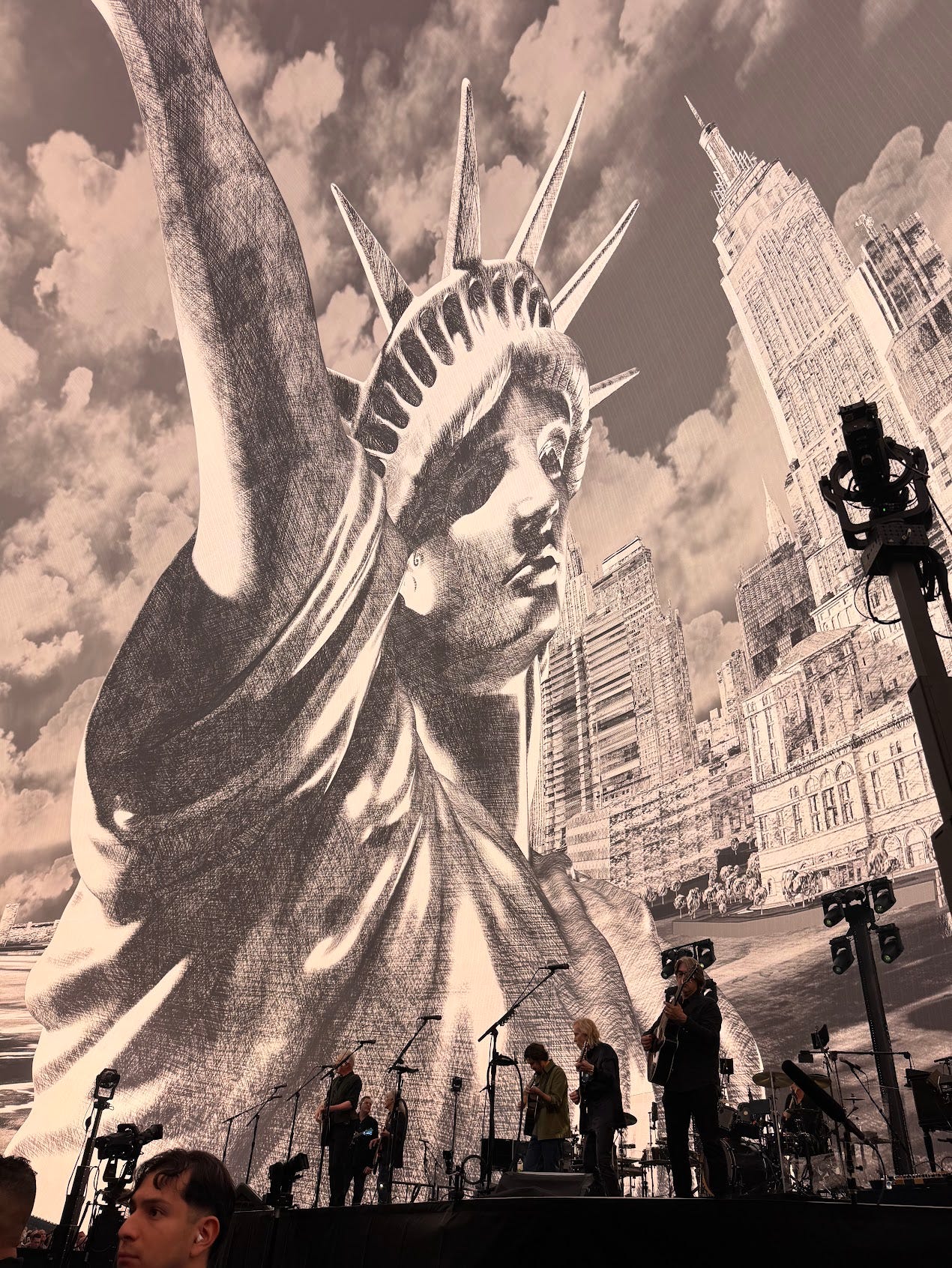
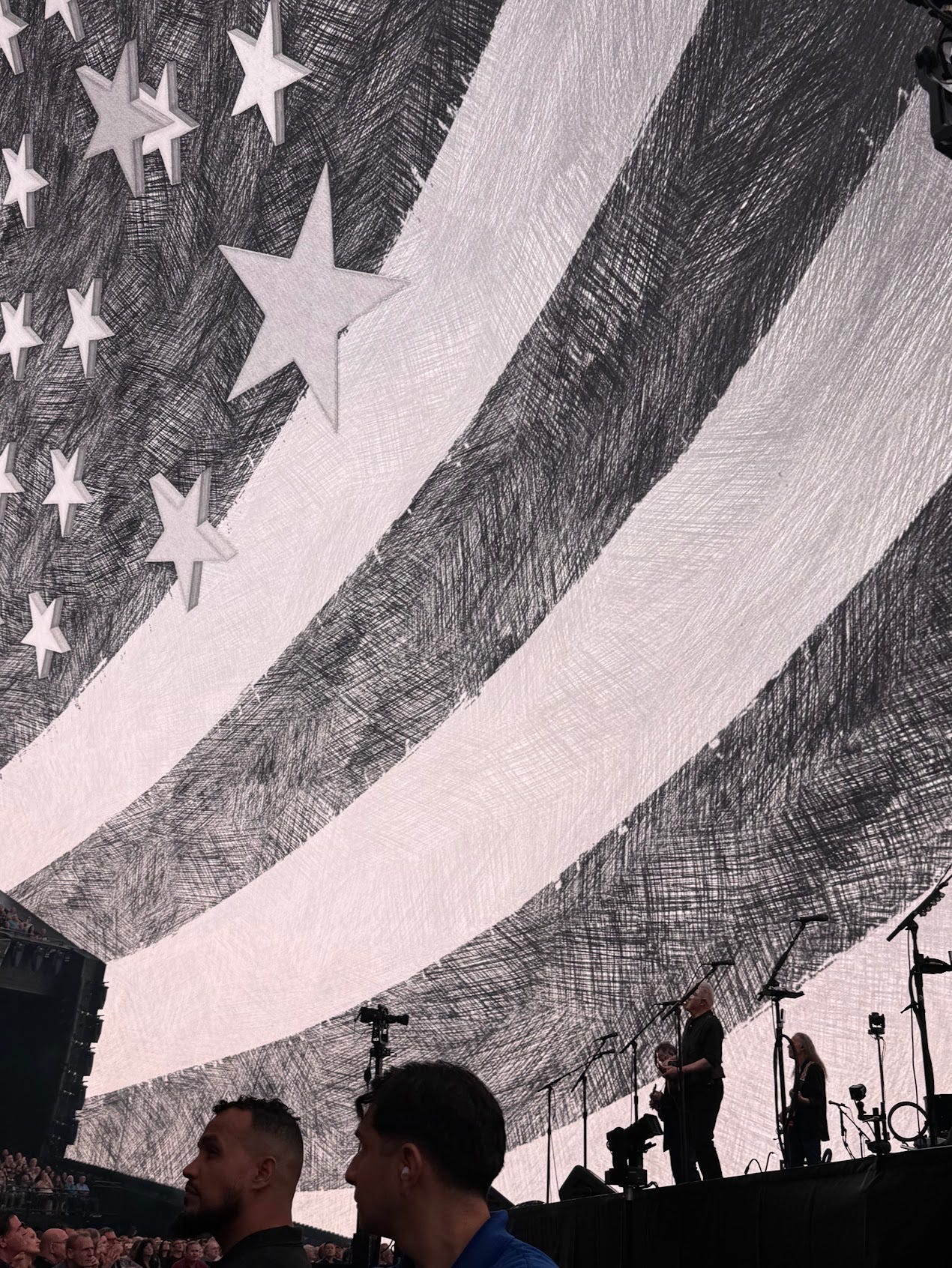
But here’s the thing about last night. Before The End of the Innocence, Henley quoted that line about history rhyming. Then the montage came: wartime footage, loss and hope braided together, a closeup of the Statue of Liberty filling the screen, and a flag that swelled until it was almost a living thing.
The crowd cheered and moved on. Most people missed the warning stitched into those images.
I did not. Because while we were at the Sphere singing about innocence and watching images that felt eerily familiar, the news was showing us how history rhymes when people stop naming what is happening.
In 1933, Germany did not wake up one morning to jackboots and concentration camps. It woke up to small, legal changes and bureaucratic remapping. Civil servants were quietly reclassified. Loyalty tests and oaths replaced merit. Departments were reorganized and then restaffed with party members. The machinery of government did not break with a crash. It was repurposed, office by office, form by form, until the shape of the state had changed so slowly that most people could not feel it happening.
That is the kind of rhyme art was trying to call out on the screen last night, and why paying attention is not optional.
This is what’s happening now, in plain terms.
They are not furloughing people. They are cutting jobs for good. These are called Reductions in Force, or RIFs, positions erased, not paused. That means the people who know how things actually run leave, and no one replaces the knowledge they take with them. When desks go dark at airports or benefits offices, it’s real people who pay the bill: missed paychecks, longer lines, services that stop working.
We built a different system for a reason. After the chaos of 19th-century patronage, Congress passed the Pendleton Act in 1883 to create a merit-based civil service, so expertise, not favoritism, would keep the country functioning. That mattered then. It matters now.
There’s an old word they used in 1930s Germany: Gleichschaltung, which they called “coordination.” It sounded technical and neat. What it actually meant was this: replace professionals with loyalists, fold independent offices into a single line, and make obedience more important than skill.
We’re watching a version of that playbook. Hollow the institutions, put loyalty in their place, and call it efficiency. The people who lose out are ordinary Americans first.
And as we sang, the quiet alarms that once kept us safe were being muted. Dozens of CDC scientists and seasoned disease detectives, the people who notice the first signals of emerging pandemics, who test the sample and draw the map of an infection’s spread, were told they are being let go. Remove that work, and you slow the alarm; a slow alarm lets a cluster become a crisis. This is not abstract. It is a practical, avoidable risk someone has chosen.
There is a brutal precedent for how this happens. When the Nazis remade Germany’s institutions they did not march in with banners that announced harm. They quietly replaced doctors and researchers who might object with people who would not. By the time most people knew anything had changed, the offices that should have protected them had been hollowed out. That is not a theory. It is a history lesson with a cost.
And nobody is safe from the fallout, not even the coastal towns and fishing families that have depended on these waters for generations.
Republicans have introduced legislation that would strip back a law that has served as a safeguard for our seas for more than fifty years, and that matters because the Marine Mammal Protection Act is not ceremonial. Passed in 1972, the MMPA gives the government authority to intervene when commercial practices threaten marine mammals: it bars the taking of whales, seals, sea otters, manatees, dolphins, polar bears, and others in U.S. waters and provides the tools to prevent incidental killings and crippling population declines.
The results have been concrete. The MMPA helped pull humpback whales back from the brink of extinction and strengthened protections for deeply imperiled species like the North Atlantic right whale and the tiny, fragile Rice’s whale, animals that do not have time for experiments or legal delays.
Now the proposed changes would do real, measurable harm: narrowing what counts as “harm,” downgrading population goals from “maximum productivity” to mere “continued survival,” and even delaying critical protections for some species until 2035, a delay that could render recovery impossible. These are not technical footnotes. They are legislative amendments that translate into more entanglements, more ship strikes, and more carcasses washing up on our shores. They would hollow out the safeguards that coastal communities and fisheries rely on.
This is not politics as usual. It is a choice about identity and stewardship: will a country that claims to cherish its coasts and natural heritage keep the laws that saved these species, or will it rewrite protections because certain industries demand easier rules? If lawmakers believe they “have enough” power to change the act, what they are deciding is whether whales and dolphins live to see another season, and whether the towns that depend on them survive.
There is an ugly echo in the past: in the 1930s, German propaganda rhapsodized forests and homeland while conservation rules that limited exploitation were quietly undone. The rhetoric was pastoral; the practice was extractive. The land paid the price.
On the world stage, the president has singled out NATO partners, pressed Spain over defense spending, and floated punitive steps. Alliances are not props for a show. They are scaffolds of trust we lean on when storms come. Treating diplomacy as theater risks fraying the very trust that keeps the world from tipping.
History gives a clear rehearsal. In the 1930s, Germany withdrew from the League of Nations and turned diplomacy into performance, testing boundaries until each unanswered provocation grew bolder. Institutions meant to prevent war became part of the act that led to it.
Yesterday, the White House disclosed the president had an annual physical, though he’d already had one six months earlier, making this effectively a second “annual” exam in one year. The post-visit note reported that he’d received a COVID booster and that an ECG placed his “cardiac age” 14 years younger than his chronological age. This was more political propaganda dressed as a medical disclosure, designed to gaslight and brainwash the public.
Many physicians pushed back, noting there is no single, sound-bite metric that can produce a “cardiac age” from an ECG. The optics run even deeper throughout this “report”. He took a booster and other protections for himself while amplifying the disinformation spread by his appointee, RFK Jr., about those same vaccines, the very tools he relies on to protect himself.
Mixed messaging is not harmless; it reshapes what people believe about truth and risk.
This pattern is chillingly familiar: leaders project control and certainty while privately using truth and facts to dictate their own care, while rewriting it for everyone else.
This isn’t a scattered list. This is a pattern. Critics point to Project 2025, to policy blueprints arguing for shrinking and reshaping the federal workforce. Hollow the institutions, replace expertise with loyalty, and governance becomes easier to command. That’s how you manufacture brittle systems: gut the bodies that know how to run the train, and the train falters.
We’re watching the Pendleton reforms reversed in practice. We’re watching Gleichschaltung in real time.
And so I keep thinking about Berlin.
In 2019, my family walked through the Topography of Terror. The museum sits on the site where the Gestapo and SS headquarters once stood. It’s not a memorial to victims. It’s an autopsy of how it happened. A guide told us plainly, teach children to recognize the small signs, the scapegoating, the incremental exclusions, the hollowing of institutions, because small signs become a mountain.
The exhibits show the paperwork. The memos. The organizational charts. How the civil service was purged between 1933 and 1935. How lawyers and judges were replaced until the courts became tools of the regime. How doctors and teachers received new guidelines, new loyalty requirements. How each profession was brought to heel, not through dramatic coups but through bureaucratic restructuring.
That museum isn’t a place for abstract moralizing. It’s an instruction manual for attention. It shows how routine offices and forms made silence seem normal, and how that silence became scaffolding for something monstrous.
One thing that stayed with me was learning about the administrative notice from 1933 about the “reorganization” of Berlin’s municipal workforce. Dry language. Procedural tone. The kind of memo you’d skim and forget. Beneath it, the museum explains: this memo led to the firing of every Jewish city employee within six weeks. The horror wasn’t in the language. It was in what the language allowed people to ignore.
Hannah Arendt, who fled Nazi Germany, wrote later that the great danger isn’t monsters in capes but the banality of evil: ordinary people following orders without thought, becoming cogs in something cruel. Obedience without conscience is the engine of catastrophe.
The Nazis didn’t invent authoritarianism. They perfected the bureaucratic version of it. They showed how you don’t need a violent coup if you can simply rewire the institutions from within. Change the incentives. Reward loyalty. Punish dissent. Make the system itself do the work. And then they showed the world what happens when no one stops it early enough.
We have our own American precedents too. McCarthyism in the 1950s turned loyalty into a test. Drive-by inquisitions hollowed institutions. Careers were destroyed, debates chilled. The country learned that loyalty tests make institutions pliant. The mechanics are familiar: make a list, name an enemy, demand loyalty, purge competence. That’s not ancient history. People who lived through it are still alive. They tried to warn us.
That pattern is why the montage at the Sphere hit differently than the crowd realized. They saw a flag and cheered. I saw Liberty and thought about attention. Art was ringing the bell. Laughter was muffling the sound.
In Berlin, they put plaques on stones where people were taken. Small brass squares embedded in the sidewalk, each one with a name, a date, a destination. Stolpersteine, stumbling stones. You can’t walk through the city without encountering them. That’s the point. Memory forced into the everyday so it becomes impossible to forget.
The Germans do this because they understand something we’re still learning: forgetting is a choice, and remembering is work. It’s how you make sure that these atrocities don’t repeat.
When you walk through that city and see those stones, when you stand in the museums built on the ruins of what was lost, you understand that the people who let it happen weren’t evil. They were tired. They were scared. They told themselves someone else would stop it. They told themselves it couldn’t get that bad. They were ordinary people who made the very human mistake of believing that their disbelief was enough to stop what was coming.
The plaques in Berlin exist because people decided that memory matters more than comfort. That future generations deserved to know not just what happened, but how it happened. How ordinary it seemed. How incremental. How preventable. Songs will be how we archive this time. Photographs will be evidence. Testimony will be the work the next generations stand on. Artists who break from expected audiences to tell the truth are doing civic labor. They pull listeners toward conscience in ways policy never does alone.
I left the Sphere with the music still in my bones, my phone full of photos, and a vow in my chest. We will not forget. We will not forget what we’re watching happen. We will not let others forget. We will teach our children to remember, not just what happened, but how to recognize it while there’s still time to stop it.
Because the next generation will ask what we did in this moment. And we will not forget our answer.
I’ll see you tomorrow,
Heather
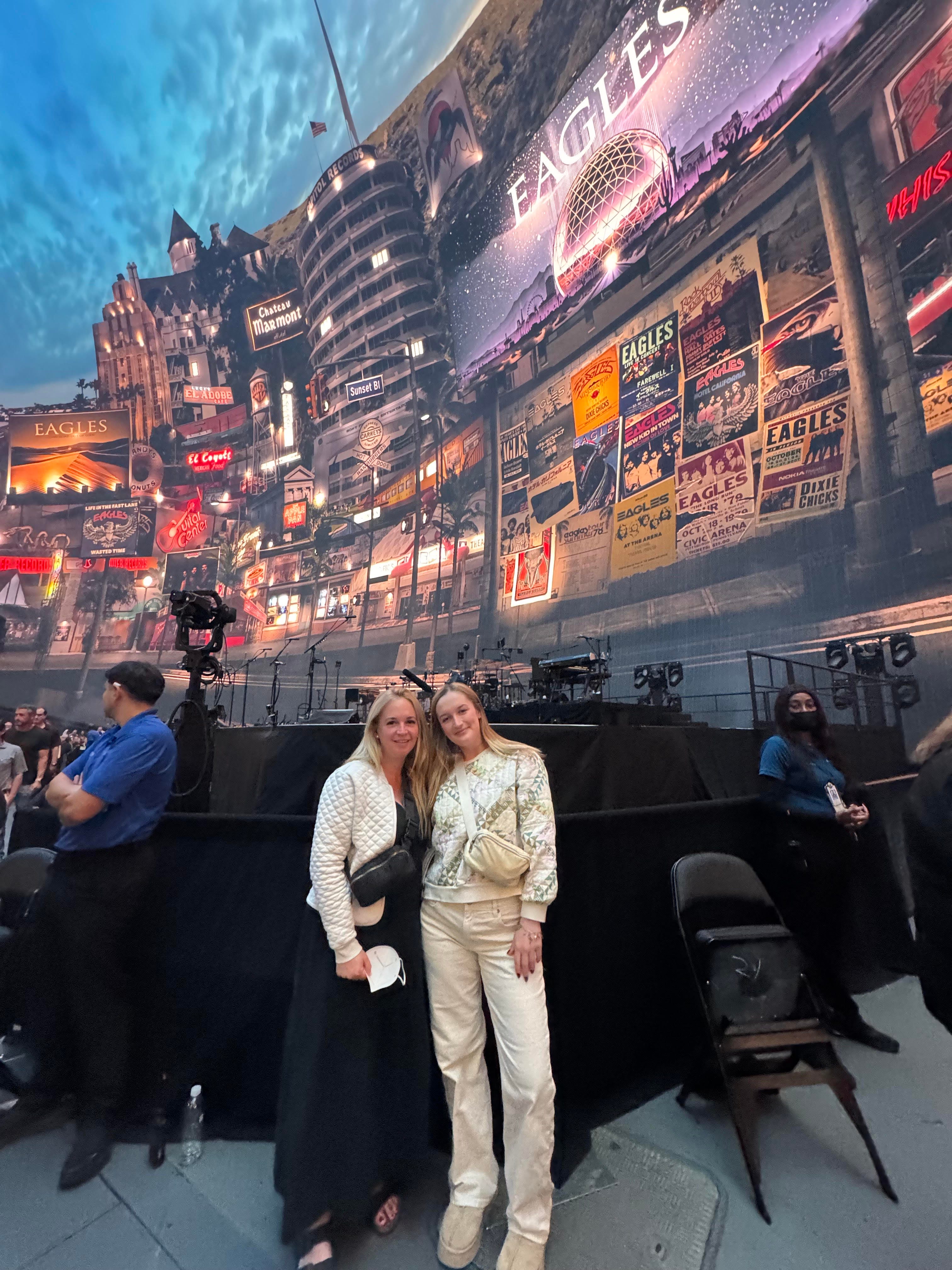
(Photo of my daughter and I pre-show.)
The Eagles are iconic, not only because of their music and harmony, but because of their meaningful and timely lyrics. They were part of my second concert back in 1976 (I am happily aging myself). I'm betting that the addition of being in the Sphere and attending with your daughter made your experience even more special.
The first song that I heard after learning of the 9/11/2001 attack was "New York Minute" by Don Henley. While the background behind the attacks and the song differ greatly, hearing those words sung over and over were chilling to me and remain so, even today.
Those attacks came from outside America. Now we're being attacked from within, from the top of our government down. Minute by minute America is changing.
Keep watching, keep listening, keep fighting, keep hoping.